Author Page:




eBook EXCERPT or SYNOPSIS
International Sales Welcome
Special Web Price:
Available as an eBook in these standard reading formats:
ePub, Mobi, PDF, AZW3, and a Zip with all formats
Don't know which eBook type you need? More Info >>>
eBook DESCRIPTION
eBook TAGS
Publisher:
Language:
Length:
SKU:
Title:
Series:
Author
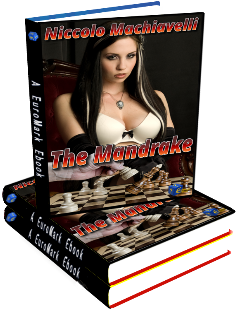
The Mandrake
$4.95
Niccolo Machiavelli
 Add to Cart
The Mandrake, the best known of Machiavelli’s three plays, was probably composed in 1518. In it a foolish old jurist, Messer Nicia, allows himself to be cuckolded by a young man, Callimaco, in order to produce a son he cannot beget himself. His wife, Lucrezia, is persuaded to comply—despite her virtue—by a crooked priest, and the conspiracy is facilitated by a procurer. Since at the end of the play everyone gets what he wants, the lesson is that immoral actions such as adultery can bring happiness—out of evil can come good.
Machiavelli also holds a place in the history of imaginative literature, above all for his play La Mandragola (1518; The Mandrake), one of the outstanding comedies of the 15th century.
Like Vittorino and other early humanists, he believed in the centrality of historical studies, and he performed a signally humanistic function by creating, in La mandragola (1518; The Mandrake), the first vernacular imitation of Roman comedy. His unswerving concentration on human weakness and institutional corruption suggests the influence of Boccaccio; and, like Boccaccio, he used these reminders less as topical satire than as practical gauges of human nature. In one way at least, Machiavelli is more humanistic (i.e., closer to the classics) than the other humanists, for while Vittorino and his school ransacked history for examples of virtue, Machiavelli (true to the spirit of Polybius, Livy, Plutarch, and Tacitus) embraced all of history—good, evil, and indifferent—as his school of reality. Like Salutati, though perhaps with greater self-
Niccolò Machiavelli’s comedy La Mandragola (The Mandrake) was most likely first performed in Florence during the carnival season of 1518, and composed sometime between 1512 and its debut. It was originally entitled Comedia di Callimaco & di Lucretia, although the author occasionally referred to the work as Comedia di Messer Nicia. While there is no definitive way to date the work precisely, the only extant manuscript of the play is from 1519. Pasquale Stoppelli convincingly argues that La Mandragola was certainly written after Machiavelli completed his vernacularization of Terence’s Andria. The comedy quickly gained popularity in other milieus, including the city of Venice during the …
Although the five-
Mandragola focuses on the interplay between personal and political ethics, a major theme throughout his works. The translation includes helpful notes that clarify allusions, language and context. Names of characters and places, titles and forms of address, and some familiar Italian words and phrases remain in Italian. Passages in Latin, as well as idioms, are reproduced in the footnotes.
OUT OF EVIL CAN COME GOOD...!
The Mandrake
La Mandragola
EuroMark
English
22,842 Words
Comedy, adultery, play, Political Science, Political Philosophy, Virtue, La Mandragola, Performance, Carnival, Political Ethics
Political Philosophy Comedy Play
EM3100004
.jpg)